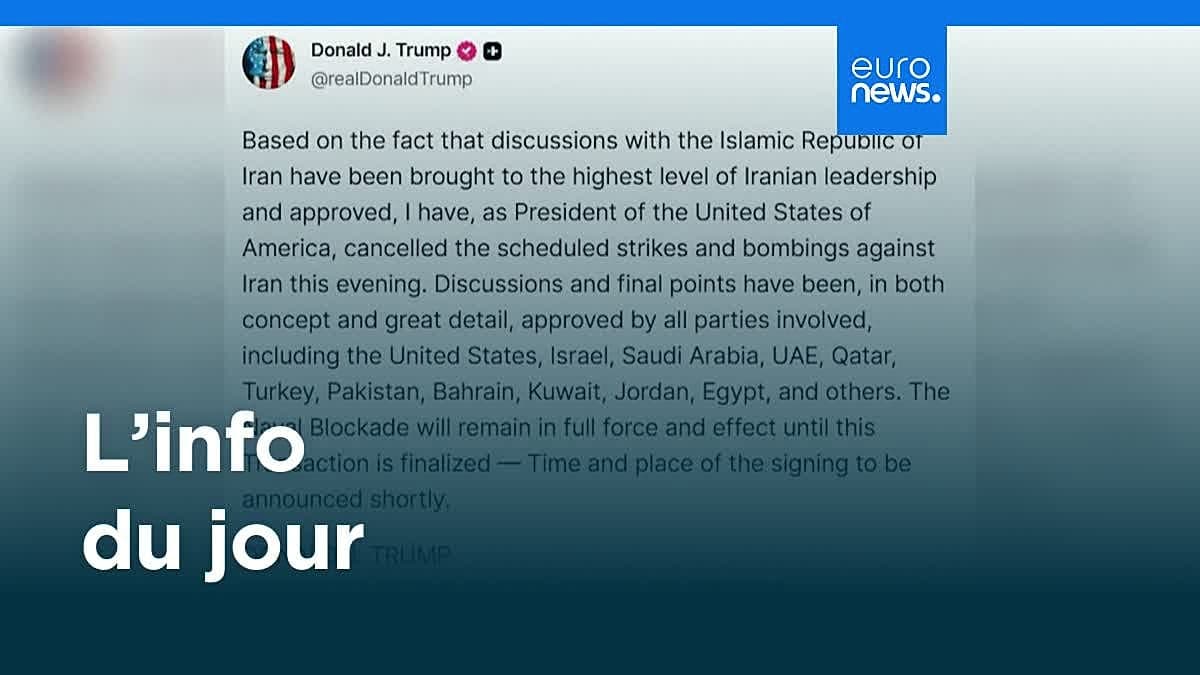
Trump pauses Iran strikes as Pakistan says deal text is agreed
US President Donald Trump called off planned strikes on Iran after saying negotiations had advanced, while Pakistan's prime minister, Shehbaz Sharif, said a final text for a US-Iran peace deal had been agreed. The claim remains provisional: Iran's foreign ministry said Tehran had not taken a final decision, and a senior Trump administration official said the proposed memorandum would be performance-based, with sanctions relief and unfrozen assets tied to Iranian compliance. The core issues are the reopening of the Strait of Hormuz, Iran's nuclear programme and the US blockade on Iranian ports. Brent crude market data showed prices fell sharply on hopes of de-escalation, then recovered partly as the terms became contested. For Europe, the centre of gravity is not bilateral US-Iran theatre but whether a deal can restore maritime security and lower energy-price pressure without weakening nuclear non-proliferation safeguards.
Verified by Validiris·📚 8 sources·🧠 AI-checked·🇧🇪 Belgian: MediumWhy you can trust this
Trump's America: From the First Term to Now
A living dossier on Donald Trump's political project, from the 2016 victory through the post-2020 contested period to his return to the White House in January 2025 — and the political, legal, economic and institutional consequences still unfolding.
About this story
Shehbaz Sharif (Pakistan's prime minister since 2024, whose government has acted as a mediator in the US-Iran talks) said the wording was agreed. Donald Trump (US president, returned to office in 2025) framed the pause in strikes as linked to diplomatic progress. Iran (Islamic Republic in the Persian Gulf, under heavy US sanctions and central to the nuclear dispute) has not formally confirmed a final deal. Abbas Araqchi (Iranian foreign minister and veteran nuclear negotiator) said a memorandum had come close. Esmaeil Baghaei (Iranian foreign ministry spokesperson) said Iranian decision-making bodies were still reviewing the text. The Strait of Hormuz (narrow sea passage between Iran and Oman) is the main energy chokepoint in the crisis. Kharg Island (Iran's main offshore oil export terminal) had been cited in US threats. Hezbollah (Iran-aligned Lebanese armed movement and party) remains part of the wider regional battlefield.
How to read this story
The history
The 2015 Joint Comprehensive Plan of Action limited Iran's nuclear activities in return for sanctions relief, with the EU acting as coordinator of the agreement's joint commission. Trump withdrew the United States from that deal on 8 May 2018, after which US sanctions returned and Iran gradually reduced compliance. The Council of the EU's 12 December 2022 conclusions reaffirmed that Iran must never develop or acquire a nuclear weapon and urged Iran to stop threats to freedom of navigation in Gulf maritime routes. The current talks revive the old bargain of nuclear restraint for economic relief, but under wartime pressure.
The geopolitics
The deal would test whether coercive escalation can be converted into a monitored settlement. Iran's leverage comes from geography, energy chokepoints and regional allies; Washington's leverage comes from military pressure, sanctions and blockade power. Europe wants de-escalation but also safeguards against a weaker nuclear settlement than the 2015 framework.
Why now
The story is timely because Trump paused planned strikes on 11 June 2026 and Pakistan's prime minister said on 12 June that a final text had been agreed, even as Iranian officials said no final decision had been taken.
What to watch
Watch for a formal Iranian decision, a possible signing venue, the G7 summit beginning on 15 June 2026, shipping data through the Strait of Hormuz, Brent crude prices and whether US officials lift or keep the blockade on Iranian ports.
Regional impact
The EU level is most directly affected because sanctions, nuclear diplomacy and maritime-security policy sit largely with EU institutions and member-state foreign ministries. Belgium's federal level is affected through energy-security planning, fuel prices and foreign-policy coordination in Brussels. Flanders, Wallonia and Brussels would feel the impact mainly through consumers, logistics firms, ports, agriculture and industrial energy users, but the available sources do not show a distinct policy divergence between the regions.
Local impact
The most local Belgian effect is on transport and industrial costs rather than security on Belgian soil. Road hauliers, port-linked logistics around Antwerp-Bruges, farms buying fertiliser and households filling cars are the groups most likely to feel any oil-price reversal or renewed shipping disruption.
International angle
The European angle is central: EU member states need lower energy volatility, credible nuclear limits and safe Gulf shipping. Brussels also matters institutionally because EU foreign ministers, sanctions lawyers and energy-security officials coordinate the European response from EU bodies based in the city.
What this means for you
For Belgian readers, nothing changes at the pump or on energy bills until a deal is signed and implemented. The practical signal is price direction: sustained reopening of Hormuz would likely reduce pressure on fuel, freight and fertiliser costs, while renewed strikes would point the other way.
What happens next
The next step is confirmation, or rejection, by Iranian decision-making bodies and any formal signing venue, with Switzerland offering to host if the parties agree. US officials are expected to keep pressing for a performance-based memorandum. Markets will watch whether shipping through the Strait of Hormuz normalises and whether the US blockade on Iranian ports is lifted or maintained.
Potential consequences
If the memorandum is signed and implemented, oil and freight markets could stabilise, easing pressure on European inflation and Belgian transport costs. If the deal collapses after public expectations have risen, the risk is a sharper rebound in crude prices, renewed military escalation and deeper mistrust around nuclear inspections. A partial deal could also leave Lebanon, Israel and Gulf maritime security unresolved.
Opposing perspectives
- Trump administration
A senior Trump administration official argues that a performance-based memorandum protects US leverage: Iran would receive economic relief only after reopening the Strait of Hormuz, dismantling nuclear capabilities and transferring highly enriched uranium. In this frame, pausing strikes is not a concession but a way to lock in compliance without giving Tehran immediate cash or sanctions relief.
- Iranian foreign ministry
Iran's foreign ministry frames the talks as unfinished and subject to review by Iranian decision-making bodies. Its strongest argument is that public US announcements should not be treated as a concluded peace until Tehran has accepted the terms, especially on red lines involving sovereignty, sanctions relief and control of maritime routes.
- EU foreign-policy institutions
The Council of the EU's conclusions frame the issue through non-proliferation and Gulf stability: Iran must not acquire a nuclear weapon, and maritime routes must remain safe under international law. From this perspective, de-escalation is valuable only if it restores verification, avoids wider regional conflict and does not normalise coercive threats to shipping.
Timeline
- 2015-07-14·Iran and the P5+1 concluded the Joint Comprehensive Plan of Action in Vienna.
- 2018-05-08·Donald Trump withdrew the United States from the JCPOA and reimposed US sanctions.
- 2022-12-12·The Council of the EU approved conclusions on Iran, nuclear non-proliferation and Gulf maritime safety.
- 2026-06-11·Trump said he was cancelling planned strikes after claiming progress toward a US-Iran agreement.
- 2026-06-12·Shehbaz Sharif said a final text had been agreed, while Iran's foreign ministry said Tehran had not made a final decision.
Glossary
- Strait of Hormuz
- A narrow sea passage between Iran and Oman that connects the Persian Gulf with the Gulf of Oman and global shipping lanes.
- JCPOA
- The 2015 Iran nuclear deal, formally the Joint Comprehensive Plan of Action, trading limits and inspections for sanctions relief.
- MOU
- A memorandum of understanding: a written political arrangement that may set commitments without necessarily being a full treaty.
- Highly enriched uranium
- Uranium enriched to levels that raise proliferation concern; deal terms reportedly cover removal or destruction of such material.
- Council of the EU
- The EU institution where member-state ministers adopt common positions, laws and foreign-policy conclusions.
Related to this story
Live connections from the Belgium Impulse ecosystem — not recommendations.
This briefing was prepared with AI assistance and reviewed by a Belgium Impulse editor before publication. methodology.