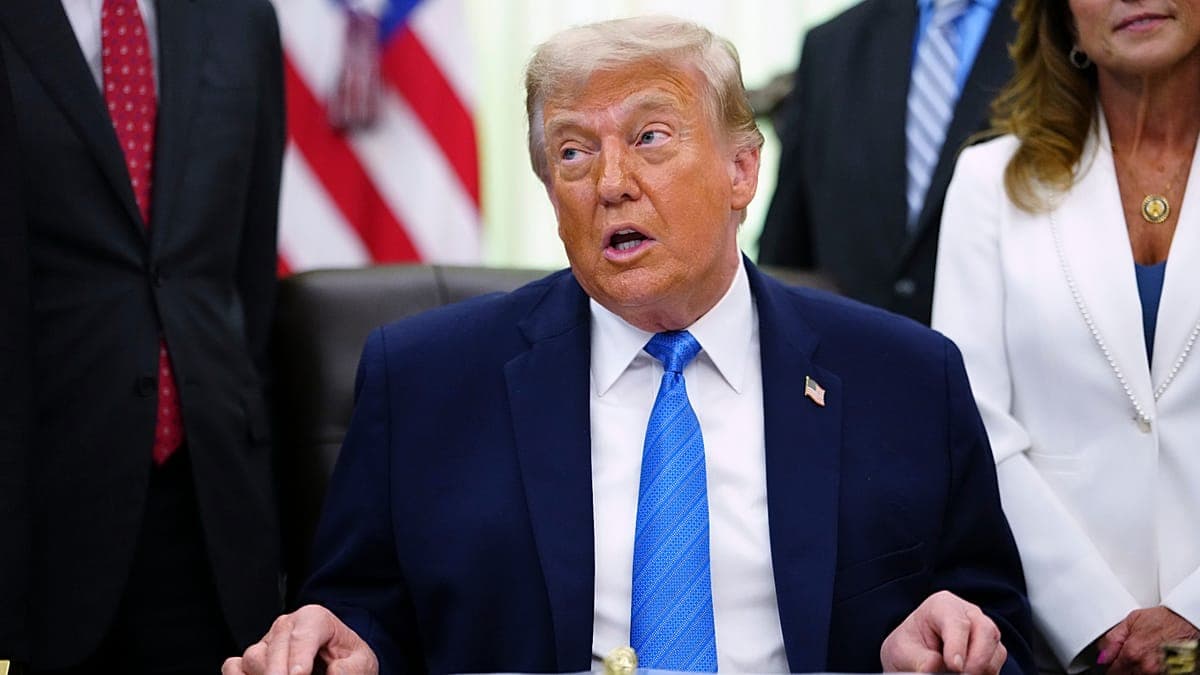
Trump defends US price surge after May inflation hits 4.2%
Donald Trump tried to cast the latest US inflation report as manageable after the U.S. Bureau of Labor Statistics said consumer prices rose 4.2% year on year in May, up from 3.8% in April. Trump said the figures were “great” and later argued that wartime energy pressure would fade once the Iran conflict eases. The central issue is not the phrase itself but the policy bind behind it: energy costs are pushing headline inflation higher while core inflation remains less heated. For Europe and Belgium, the story matters as an early signal of how a Gulf energy shock can move through fuel, air fares, shipping, food inputs and central-bank expectations. The Federal Reserve’s next rate decision will be watched well beyond Washington because US rates shape the dollar, global borrowing costs and market conditions for European firms and investors.
Verified by Validiris·📚 8 sources·🧠 AI-checked·🇧🇪 Belgian: MediumWhy you can trust this
Trump's America: From the First Term to Now
A living dossier on Donald Trump's political project, from the 2016 victory through the post-2020 contested period to his return to the White House in January 2025 — and the political, legal, economic and institutional consequences still unfolding.
About this story
Donald Trump (US president, returned to office in January 2025) is the political actor defending the inflation figures. The U.S. Bureau of Labor Statistics (federal statistical agency within the US Labor Department) publishes the Consumer Price Index, the main US household inflation gauge. The Consumer Price Index (CPI, monthly US price basket) tracks changes in prices paid by urban consumers. The Federal Reserve (US central bank, created in 1913) sets US monetary policy and targets 2% inflation over time. Kevin Warsh (Federal Reserve chair in current reporting, former Fed governor from 2006 to 2011) is leading the central bank into its June meeting. Iran (Islamic Republic in the Persian Gulf) is central because the conflict has disrupted energy markets. The Strait of Hormuz (narrow Gulf shipping chokepoint between Iran and Oman) is a critical oil and LNG route. The European Central Bank (Frankfurt-based eurozone central bank) is relevant because imported energy shocks can complicate euro-area inflation policy.
How to read this story
The history
The U.S. Bureau of Labor Statistics said US inflation peaked at 9.1% in June 2022 before easing, a reminder that energy and supply shocks can move headline prices fast. The 1973 oil embargo and the 1979 Iranian revolution both produced inflationary energy shocks in advanced economies. Europe’s most recent precedent came after Russia’s full-scale invasion of Ukraine in February 2022, when gas and electricity prices fed into household bills, public subsidies and wage negotiations. The current Gulf shock is different in geography, but the policy question is familiar: whether a temporary energy surge becomes embedded in broader expectations.
The geopolitics
The economic story sits inside the broader Iran conflict and the vulnerability of global energy chokepoints. The U.S. Energy Information Administration has identified the Strait of Hormuz as central to oil flows, so military pressure there becomes a price-setting event for households far from the Gulf. That gives Iran, the US and Gulf producers leverage beyond the battlefield, through inflation and supply expectations.
Why now
The trigger is the May CPI release on June 10, which showed US annual inflation accelerating to 4.2%. Trump’s public defence of the figures turned a statistical release into a political and market story just before the Federal Reserve’s June meeting.
What to watch
Watch the Federal Reserve’s June decision, the next US CPI release, oil and LNG traffic through the Strait of Hormuz, and whether core inflation follows energy prices higher. For Belgium and the euro area, the key signal is whether imported energy pressure appears in fuel, air fares, freight and food inputs.
Local impact
The most concrete Belgian local exposure is around Antwerp-Bruges port and Brussels Airport, where fuel, insurance, freight and aviation costs are sensitive to global energy disruption. The US CPI report does not change local prices by itself, but it signals the same cost pressures that logistics firms, airlines and import-dependent businesses in those hubs must price into contracts.
International angle
This is an international inflation story with a European transmission channel. US inflation affects Federal Reserve policy, the dollar and global bond yields, while Gulf energy disruption can feed into European fuel, gas, freight and food-input prices. Belgium enters as a small, open euro-area economy exposed to imported energy and trade costs rather than as a decision-maker in the US data.
What this means for you
Belgian readers do not need to react to a US CPI print directly, but businesses should stress-test fuel, freight and currency assumptions if they trade in dollars or depend on transport-heavy supply chains. Households planning long-haul travel may see air fares remain sensitive to jet-fuel prices. Investors should expect central-bank messaging to stay cautious while energy prices remain volatile.
What happens next
The Federal Reserve’s June policy meeting is the immediate next test. Officials could hold rates steady while watching whether energy-driven headline inflation spreads into core prices and expectations. Markets will also watch oil flows through the Strait of Hormuz, US gasoline prices, airline fares and the next CPI release. For Europe, the European Central Bank will monitor whether imported energy pressure complicates its own inflation path.
Potential consequences
If the energy shock fades quickly, the May reading may prove a political embarrassment more than a structural inflation break. If it persists, US rates could stay higher for longer, the dollar could strengthen, and euro-area import costs could rise. Belgian firms may face higher fuel, freight and insurance bills, while households could see pressure in travel and energy-linked goods. The larger risk is a feedback loop in which temporary energy prices reshape expectations.
Opposing perspectives
- Trump administration
The Trump administration’s strongest case is that the May CPI report shows a temporary energy shock rather than a broad loss of price control. White House spokesperson Kush Desai said falling prices in some essentials show the administration’s affordability agenda is still working, while Trump said inflation should ease once the Iran conflict is resolved.
- Federal Reserve inflation hawks
Federal Reserve inflation hawks would argue that headline inflation above target cannot be dismissed while energy costs are feeding public expectations. The U.S. Bureau of Labor Statistics said CPI reached 4.2%, and the Fed’s credibility depends on preventing a temporary oil shock from spreading into wages, services and longer-term pricing behaviour.
- European energy consumers and SMEs
European households and SMEs can read the US data as a warning that Gulf energy disruptions are not geographically contained. The U.S. Energy Information Administration has identified the Strait of Hormuz as a vital oil route, and any prolonged pressure can raise fuel, shipping and input costs before domestic statistics fully capture the effect.
Timeline
- 2022-06·The U.S. Bureau of Labor Statistics said US annual CPI inflation peaked at 9.1%.
- 2026-04·The U.S. Bureau of Labor Statistics said annual CPI inflation stood at 3.8%.
- 2026-06-10·The U.S. Bureau of Labor Statistics said annual CPI inflation rose to 4.2% in May.
- 2026-06-10·Trump said the inflation figures were “great” and defended the report publicly.
Glossary
- CPI
- Consumer Price Index, a monthly measure of prices paid by households for a basket of goods and services.
- Core inflation
- Inflation excluding food and energy, used by central banks to assess underlying price pressure.
- Second-round effects
- A process in which an initial price shock feeds into wages, expectations and broader prices.
- Strait of Hormuz
- A narrow Gulf shipping route between Iran and Oman that carries a major share of global oil and LNG trade.
Related to this story



Live connections from the Belgium Impulse ecosystem — not recommendations.
This briefing was prepared with AI assistance and reviewed by a Belgium Impulse editor before publication. methodology.