Trump and Pezeshkian sign Iran war MoU to reopen Hormuz
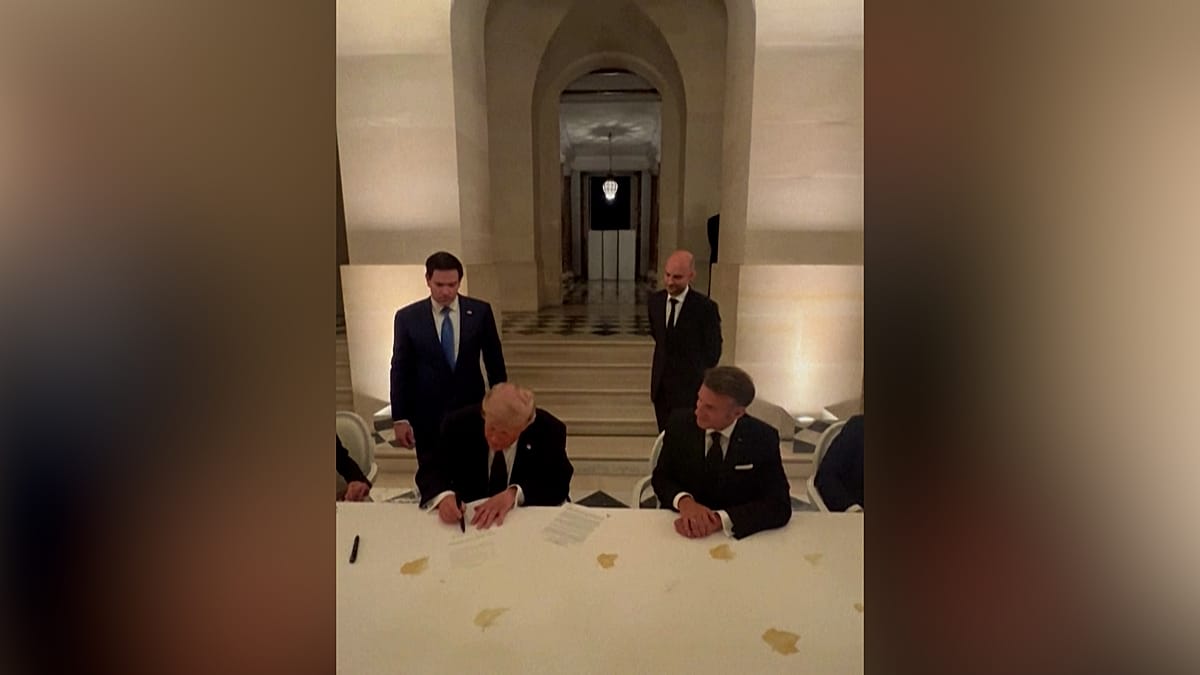
U.S. officials said Donald Trump and Masoud Pezeshkian signed a memorandum of understanding intended to halt the U.S.-Iran war, reopen the Strait of Hormuz and start a 60-day push toward a final settlement. The draft read to journalists by senior U.S. officials includes toll-free passage through Hormuz for 60 days, a minimum standard for down-blending Iran's highly enriched uranium and U.S. sanctions waivers rather than full sanctions removal. Iranian officials have not published the text, and Iran's negotiator Mohammad Bagher Ghalibaf said Tehran still expects a future role over transit fees. The immediate effect is de-escalation in a conflict that the International Energy Agency described in March as causing the largest supply disruption in oil-market history. The deal is therefore less a finished peace than a high-stakes framework: it lowers near-term energy and security pressure while leaving nuclear verification, shipping guarantees, Lebanon and sanctions sequencing unresolved.
Trust & Evidence📚 5 sources· ✓ Editor reviewed· 🧠 AI-checked· Trust status: not yet independently verifiedView evidence & verification Hide
Verification record
- 📚 5 verified sources — Al Jazeera liveblog: Iran war live: Trump, Pezeshkian sign MoU to end fighting, reopen Hormuz · Associated Press: The Latest: Trump says he signed an agreement on ending the war in Iran while at Versailles · Axios: U.S. and Iran sign deal ahead of schedule, sources say · The Guardian liveblog: Middle East crisis live: agreement signed by US-Iran presidents …
- 🧠 High confidence — AI-checked, editor-approved
- 🇧🇪 Belgian impact: Medium
- 📜 Provenance recorded & timestamped
Evidence is generated from the OIS evidence chain and reviewed before appearing on Belgium Pulse.
Powered by OIS / Evidentia
Trump's America: From the First Term to Now
A living dossier on Donald Trump's political project, from the 2016 victory through the post-2020 contested period to his return to the White House in January 2025 — and the political, legal, economic and institutional consequences still unfolding.
About this story
Donald Trump (U.S. president, serving his second term in 2026) signed the MoU with Masoud Pezeshkian (Iranian president elected in 2024 after Ebrahim Raisi's death). The Strait of Hormuz (narrow waterway between Iran, Oman and the Persian Gulf) is a critical oil and LNG route. Mohammad Bagher Ghalibaf (speaker of Iran's parliament and senior negotiator) is a conservative figure close to Iran's security establishment. The IAEA (International Atomic Energy Agency, UN-linked nuclear watchdog based in Vienna) would be central to verifying any uranium down-blending. Hezbollah (Lebanese armed movement and political party backed by Iran) links the Iran deal to Lebanon and Israel. The G7 (Group of Seven advanced economies) met in France as the framework emerged. The UN Security Council (15-member body responsible for binding peace and security decisions) would be needed if the framework becomes a formal resolution.
How to read this story
The history
The framework echoes the 2015 Joint Comprehensive Plan of Action, under which Iran accepted nuclear limits and monitoring in exchange for sanctions relief before Trump withdrew the United States in 2018. It also follows the 2025 Twelve-Day War ceasefire, which temporarily reduced Iran-Israel escalation but did not remove the underlying nuclear and regional-security disputes. In 2026, the conflict escalated after U.S.-Israeli strikes on 28 February and Iran's closure or restriction of Hormuz. The International Energy Agency said on 11 March that member countries agreed to make 400 million barrels from emergency reserves available, underscoring how quickly a regional war became a global economic problem.
The geopolitics
The deal shows how a regional war can quickly become a contest over global economic infrastructure. Iran's leverage came from a maritime chokepoint, the United States used sanctions and military pressure, and Europe mainly absorbed the energy-security risk. China, Gulf producers, insurers and shipowners also matter because reopening Hormuz requires commercial confidence, not only presidential signatures.
Why now
The immediate trigger is the reported signing of the MoU on 17 June 2026 after days of uncertainty over whether the text would be released and whether the parties would wait for a Switzerland meeting. The economic pressure from disrupted Hormuz flows made a rapid framework more urgent.
What to watch
Watch whether commercial ships actually resume Hormuz transits, whether Iran tries to define future fees after the 60-day toll-free period, whether the IAEA receives inspection terms, and whether the parties publish a final text. A UN Security Council track would signal a more durable settlement.
Regional impact
The effects split mainly between the EU level and Belgium's federal level. EU institutions would be pulled into sanctions coordination, energy-market monitoring and any maritime-security debate if Hormuz remains contested. Federal Belgium would track fuel-security obligations, foreign-policy alignment and consequences for Belgian consumers and companies through the economy ministry, energy authorities and EU decision-making. Flanders, Wallonia and Brussels are not differently targeted by the MoU itself; their exposure would come through common energy prices, logistics costs and inflation channels rather than separate regional rules.
Local impact
The most local Belgian effect is in Brussels, where EU sanctions, energy-security and maritime-policy discussions would be coordinated across institutions. The Port of Antwerp-Bruges and Belgian logistics operators would feel any shipping-price normalization indirectly through freight, fuel and insurance costs, but the MoU does not create a Belgium-specific operational change by itself.
International angle
The European dimension is central but secondary to the U.S.-Iran bargain. EU governments need Hormuz open to stabilize energy and fertiliser markets, yet they are not the signatories. If the framework advances, Brussels will likely focus on sanctions compatibility, IAEA verification support, maritime-security coordination and whether any UN Security Council text preserves free navigation.
What this means for you
Belgian readers should expect possible easing in fuel and freight pressure only if shipping and insurance markets trust the ceasefire. No household or business rule changes immediately. Companies with energy, fertiliser, chemical or long-distance logistics exposure should watch contract prices and delivery timelines rather than assume that a signed MoU instantly restores pre-war costs.
What happens next
The parties are expected to test the 60-day framework through talks on nuclear limits, sanctions sequencing, shipping access and Lebanon-related guarantees. Senior U.S. officials said either side could still walk away before a final deal. The practical next signals are whether Iran allows safe commercial transits, whether insurers and shipowners return, whether the IAEA receives a defined verification role and whether a UN Security Council route emerges.
Potential consequences
If the framework holds, oil and product flows could recover gradually, easing inflation pressure for Europe and Belgium without solving all supply-chain problems. If it fails, shipping insurers may keep premiums high, EU energy planning could stay defensive and U.S.-Iran escalation could return quickly. A future Iranian fee regime for Hormuz would also create a legal and commercial dispute over free navigation, with costs likely passed through to cargo owners and consumers.
Opposing perspectives
- Trump administration
Senior U.S. officials frame the MoU as a pragmatic halt to a costly war: it reopens Hormuz, starts nuclear talks, requires uranium down-blending and avoids an energy shock that the White House says could have deepened into wider economic crisis.
- Iranian negotiators
Iranian negotiator Mohammad Bagher Ghalibaf's position is that the strait should not return to pre-war conditions. In that frame, reopening Hormuz is not surrender but recognition that Iran and Oman should have a continuing role over transit arrangements and services.
- U.S. Republican hawks
Senators Bill Cassidy and Ted Cruz argue the framework rewards coercion: Iran closed or threatened a global chokepoint, receives sanctions waivers and may retain leverage over future tolls while the missile and proxy questions remain unresolved.
- Energy-market analysts
Energy specialists quoted in the reporting treat reopening Hormuz as an immediate supply relief rather than a strategic settlement. Their strongest argument is that more Iranian and Gulf barrels reduce near-term shortages, but insurance, security guarantees and the final text determine whether flows normalize.
Timeline
- 2015-07-14·Iran and world powers agreed the Joint Comprehensive Plan of Action on Iran's nuclear programme.
- 2018-05-08·The United States withdrew from the 2015 nuclear deal under President Donald Trump.
- 2025-06-24·A ceasefire took effect after the Twelve-Day War between Iran and Israel.
- 2026-02-28·The United States and Israel launched strikes on Iran, triggering the 2026 war and Hormuz crisis.
- 2026-03-11·The International Energy Agency said member countries agreed to make 400 million barrels from emergency reserves available.
- 2026-06-17·U.S. officials said Trump and Pezeshkian signed the MoU to halt the war and reopen Hormuz.
- 2026-08-16·The reported 60-day window for a final deal would expire around this date if counted from 17 June.
Glossary
- MoU
- A memorandum of understanding: a political framework or preliminary agreement that may not yet be a binding treaty.
- Down-blending
- The process of mixing highly enriched uranium with lower-enriched or natural uranium to reduce its suitability for weapons use.
- Sanctions waiver
- A temporary permission to bypass or suspend specific sanctions without permanently removing the legal sanctions regime.
- IAEA
- The International Atomic Energy Agency, the Vienna-based nuclear watchdog that verifies declared nuclear activities.
- UN Security Council resolution
- A formal decision by the UN's 15-member security body that can make peace, sanctions or security measures legally binding under international law.
Related to this story
Live connections from the Belgium Impulse ecosystem — not recommendations.
This briefing was prepared with AI assistance and reviewed by a Belgium Impulse editor before publication. methodology.