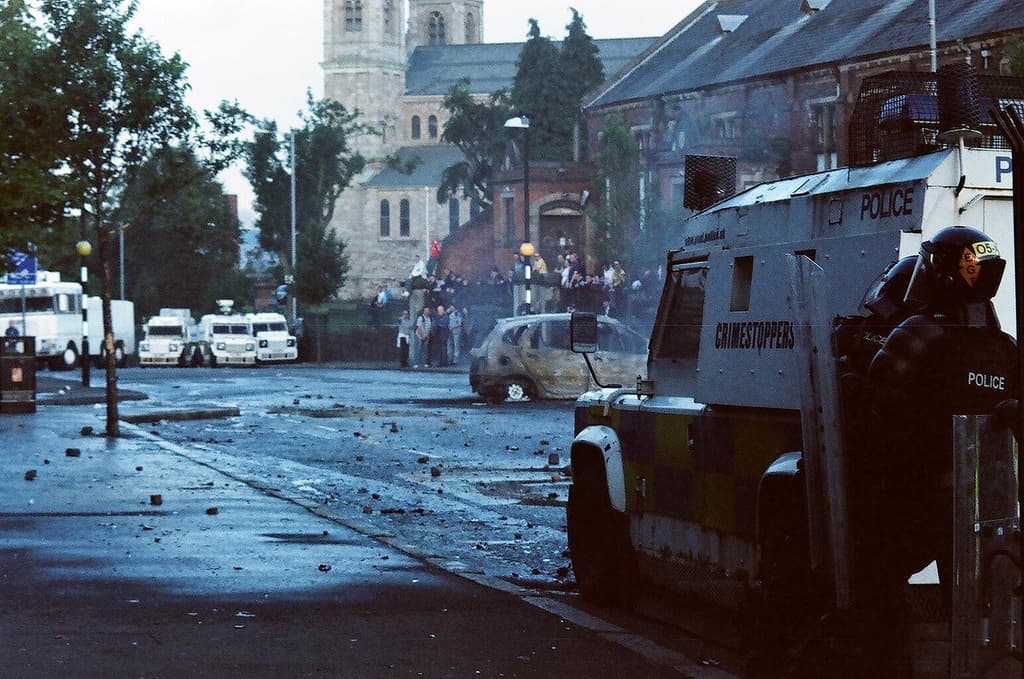
Belfast police pursue rioters after anti-immigrant attacks
Police and court accounts say violence spread across Belfast after Hadi Alodid, a Sudanese man, was charged with attempted murder over the 8 June knife attack on Stephen Ogilvie. UK and Northern Irish officials said rioters then targeted homes, businesses and streets associated with migrants, while the Police Service of Northern Ireland said officers were injured and arrests were continuing. Community organisations said targeted address lists and online mobilisation had intensified fear among ethnic-minority residents, with some families leaving homes or closing businesses early. The central story is not immigration policy alone but the speed with which a criminal case became collective punishment against minorities. For Belgium Pulse readers, the lesson sits at the intersection of public order, platform governance and migration politics: Brussels-based EU institutions are already regulating large platforms for systemic risks, while Belgian residents recognise similar tensions around disinformation, policing and social cohesion.
Evidenced on the trust ledger·📚 7 sources·🧠 AI-checked·🇧🇪 Belgian: LowWhy you can trust this
About this story
Belfast (capital of Northern Ireland, part of the United Kingdom) has a long history of street disorder rooted in sectarian conflict. The Police Service of Northern Ireland, or PSNI (Northern Ireland’s post-2001 police force), is handling the riot investigations. Hadi Alodid (Sudanese defendant, aged 30 in court accounts) has been charged over the knife attack on Stephen Ogilvie (Belfast victim whose family appealed for calm). Hilary Benn (UK secretary of state for Northern Ireland since 2024) condemned the disorder. Michelle O’Neill (Sinn Féin first minister of Northern Ireland) leads the devolved executive at Stormont (Northern Ireland’s parliament and government complex). Gavin Robinson (Democratic Unionist Party leader and MP for Belfast East) linked the case to border controls. Tommy Robinson (far-right activist Stephen Yaxley-Lennon) and Elon Musk (owner of X) were named in reporting on online amplification. The Common Travel Area (UK-Ireland travel arrangement predating EU membership) shapes the border debate.
How to read this story
The history
Northern Ireland’s recent unrest has clear precedents. In June 2025, police and prosecutors dealt with anti-immigrant disorder after allegations against two Romanian-speaking teenagers in Ballymena; later reporting and court updates said the charges were dropped, while community accounts described lasting fear among Roma residents. In 2024, UK riots after the Southport murders showed how false or inflammatory claims about suspects could travel through social platforms before police confirmed facts. The 1998 Good Friday Agreement reduced large-scale political violence, but Belfast’s geography of identity, marching-season tensions and interface areas still gives street mobilisation a dangerous local grammar.
The geopolitics
The unrest fits a wider Western pattern in which migration, identity politics and platform amplification interact with local grievances. The 2025 arXiv study by Akshay Verma, Richard Sear, Nicholas J. Restrepo and Neil F. Johnson argues that UK city riots were fed by transnational online influence networks, suggesting Belfast is part of a broader security and democratic-resilience problem rather than a purely local disturbance.
Why now
The trigger was the 8 June knife attack in Belfast and the rapid spread of video and claims about the suspect. Community organisations said previously circulated address lists and anti-HMO agitation meant the city already had a combustible online environment before the latest callouts.
What to watch
Watch for PSNI arrest totals and charging decisions, the next court dates in the attempted-murder case, any Stormont or UK parliamentary scrutiny of police preparedness, and whether platform regulators or ministers identify specific online posts as illegal incitement rather than protected political speech.
International angle
The cross-border dimension runs through the UK-Ireland Common Travel Area and through online mobilisation that does not respect national boundaries. GOV.UK guidance says the CTA is separate from EU membership, but the Belfast debate inevitably touches Ireland, post-Brexit border politics and the European question of how platforms should respond when viral content precedes street violence.
What this means for you
For Belgian and EU readers, nothing changes legally day to day. The practical takeaway is institutional: local authorities, schools, employers and community groups should treat targeted address-sharing and calls to gather at minority-owned premises as public-safety signals, while EU staff should watch how DSA enforcement handles platform-amplified intimidation risks.
What happens next
Police investigations and court proceedings are expected to continue on two tracks: the attempted-murder case against Hadi Alodid and the public-order cases against alleged rioters. UK and Northern Irish ministers could face pressure over PSNI capacity, online incitement and the Common Travel Area. EU policymakers are likely to watch whether platform-risk rules offer useful lessons beyond the EU’s borders.
Potential consequences
If the disorder is not contained, Belfast could see deeper mistrust between minority communities, police and local politicians. Businesses may close early, families may relocate, and health or care employers could find recruitment harder if overseas workers feel unsafe. Politically, the violence could strengthen calls for tougher migration controls while also increasing pressure on platforms and police to act earlier on targeted intimidation.
Opposing perspectives
- UK and Northern Irish authorities
UK and Northern Irish authorities frame the violence as criminal disorder and intimidation, not legitimate protest. Their strongest case is that a serious individual attack must be prosecuted through courts, while arson, attacks on police and threats to migrant families undermine public safety and risk collective punishment.
- Democratic Unionist Party / border-control advocates
The Democratic Unionist Party and border-control advocates argue that the case exposes weaknesses in UK-Ireland migration controls. Their strongest argument is that the Common Travel Area and the open Irish land border leave Northern Ireland politically exposed when asylum and security systems fail to reassure local residents.
- Civil-rights and migrant-support groups
Civil-rights and migrant-support groups argue that the riots were not spontaneous community concern but targeted racial intimidation. Their strongest case is that address lists, anti-HMO agitation and online calls to gather show pre-existing mobilisation that turned minority families, workers and students into targets.
- EU platform-regulation constituency
EU platform-regulation officials would read the Belfast unrest as evidence that public-security risk can move across borders through very large platforms. The European Commission’s DSA framework treats amplification of illegal content and threats to civic discourse as systemic risks requiring mitigation, transparency and researcher scrutiny.
Timeline
- 2026-06-08·Police and court accounts say Stephen Ogilvie was seriously injured in a knife attack in Belfast.
- 2026-06-10·Court accounts say Hadi Alodid appeared on charges including attempted murder.
- 2026-06-10·UK and Northern Irish officials said anti-immigrant disorder escalated with arson, attacks on police and intimidation of residents.
- 2026-06-11·Officials and community groups reported continuing unrest, injuries to officers and fear among migrant communities.
- 2026-06-12·Police accounts cited in corroborating reports said arrests were continuing after a calmer night.
Glossary
- Digital Services Act
- An EU regulation enforced by the European Commission and national coordinators that sets platform duties on illegal content, transparency and systemic-risk mitigation.
How this story developed
2 reports on this subject — earliest first. You are reading the highlighted entry.
Related to this story
Live connections from the Belgium Impulse ecosystem — not recommendations.
This briefing was prepared with AI assistance and reviewed by a Belgium Impulse editor before publication. methodology.