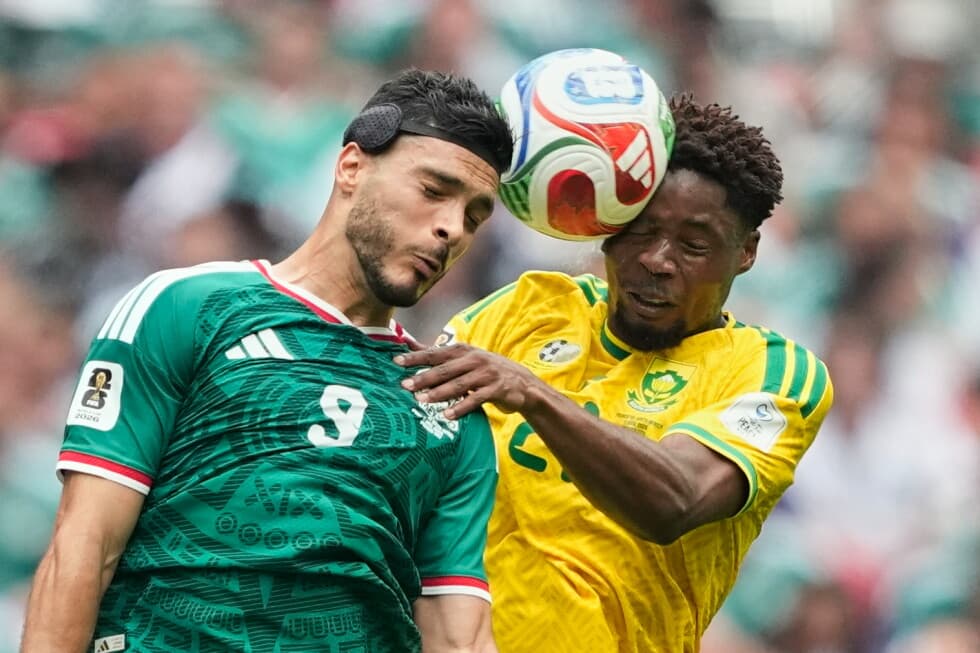
Mexico beats South Africa as red cards dominate World Cup opener
Mexico opened the 2026 FIFA World Cup with a 2-0 win over South Africa at Estadio Azteca, but the match was defined as much by discipline as by the score. Match reports state that Julián Quiñones and Raúl Jiménez scored for the co-hosts, while Sphephelo Sithole and Themba Zwane were sent off for South Africa and César Montes was dismissed for Mexico in stoppage time. FIFA's tournament rules make each red card an automatic next-match suspension, so the opener immediately affects both teams' Group A plans. The result gives Mexico early control in a group that also includes South Korea and Czechia. For Belgian readers, the sporting lesson is direct but secondary: Belgium starts its own Group G campaign against Egypt on 15 June and will play under the same disciplinary, VAR and hydration-break regime that shaped the first match.
Verified by Validiris·📚 7 sources·🧠 AI-checked·🇧🇪 Belgian: LowWhy you can trust this
About this story
Estadio Azteca (Mexico City's landmark football stadium, renamed Mexico City Stadium for FIFA sponsorship purposes in 2026) hosted the opener. Mexico (one of the three 2026 co-hosts with the United States and Canada) began Group A at home. South Africa (the 2010 World Cup host and a CAF qualifier for 2026) returned to the tournament finals. Julián Quiñones (Mexico forward) scored the opening goal, while Raúl Jiménez (Mexico striker and long-serving international) added the second. Sphephelo Sithole (South Africa midfielder), Themba Zwane (South Africa attacking midfielder) and César Montes (Mexico defender) were the three dismissed players. Javier Aguirre (Mexico head coach, in his third spell with the national team) leads the host side. Hugo Broos (Belgian coach of South Africa since 2021) argued after the match that Zwane's dismissal was harsh. Group A (Mexico, South Africa, South Korea and Czechia) decides early knockout routes in the expanded 48-team tournament.
How to read this story
The history
The fixture carried an echo of 11 June 2010, when South Africa and Mexico drew 1-1 in the opening match of the South Africa World Cup. Estadio Azteca also hosted World Cup finals in 1970 and 1986, making Mexico the first country to host or co-host the men's tournament three times. The three dismissals approached the modern benchmark for World Cup disorder: the Portugal-Netherlands round-of-16 match on 25 June 2006, widely known as the Battle of Nuremberg, produced four red cards and 16 yellows. The 2026 opener therefore put refereeing discipline at the centre of the tournament from day one.
Why now
The story is timely because the 2026 World Cup began on 11 June and its first match immediately produced a result, three dismissals and an early test of FIFA's disciplinary framework.
What to watch
Watch FIFA's disciplinary confirmations for Sithole, Zwane and Montes, then Mexico's next Group A match against South Korea and South Africa's response against Czechia. For Belgium, the next signal is the Red Devils' 15 June opener against Egypt.
Local impact
The clearest local Belgian link is the national football audience: cafés, fan zones and households following the Red Devils will now watch Belgium's opener with a concrete example of how fast discipline can alter a World Cup match. Hugo Broos's role with South Africa also gives Belgian football followers a familiar figure inside the opener's fallout.
International angle
The match launched a World Cup spread across Mexico, the United States and Canada, with Group A matches in Mexico and later knockout paths shaped by the expanded 48-team format. It also showed how FIFA's global rule choices, from VAR use to hydration breaks and suspension rules, will standardise match conditions across very different climates and venues.
What this means for you
Belgian viewers should expect tournament matches to feel longer and more stop-start than a normal league game because VAR checks and hydration breaks are built into the event. Red Devils fans should also track cards closely: in the expanded group stage, suspensions and fair-play points can become qualification factors.
What happens next
Mexico next prepares for South Korea, while South Africa must regroup for Czechia with suspensions following the red cards. FIFA's disciplinary process could confirm or extend sanctions depending on the referee's report. Belgium's first direct tournament test comes on 15 June against Egypt, where the Red Devils and Belgian viewers will get their own look at how consistently the new match-management rhythm is applied.
Potential consequences
If the opener's strict disciplinary pattern continues, coaches may adjust pressing, tactical fouls and emotional touchline behaviour earlier than usual. Teams with thin squads could be punished quickly by suspensions, while deeper sides may absorb disruption better. For broadcasters and Belgian venues screening matches, hydration breaks and VAR pauses could also change the feel of live coverage, making matches longer and more segmented than many viewers expect.
Opposing perspectives
- South Africa / Hugo Broos
Hugo Broos argued that Zwane's dismissal was too severe, a frame that treats the opener less as proof of South African indiscipline than as an example of strict tournament refereeing changing a contest that was already difficult for the underdog.
- FIFA refereeing framework
FIFA's regulations support a hard line on dismissals and automatic suspensions, framing strict discipline as a way to protect match control and player safety across a 104-match tournament rather than as a one-off overreaction in the opener.
Timeline
- 2010-06-11·South Africa and Mexico drew 1-1 in the opening match of the 2010 World Cup.
- 2025-05-01·FIFA's 2026 World Cup regulations set the tournament's disciplinary framework.
- 2026-06-11·Mexico beat South Africa 2-0 in the 2026 World Cup opener, with three players sent off.
- 2026-06-15·Belgium are scheduled to open Group G against Egypt in Seattle.
Glossary
- VAR
- Video Assistant Referee, the system that lets match officials review defined incidents such as goals, penalties, red cards and mistaken identity.
- Fair-play points
- A FIFA group-stage tiebreaker that deducts points for yellow and red cards when teams remain level on sporting criteria.
- Group G
- Belgium's 2026 World Cup group, containing Belgium, Egypt, Iran and New Zealand.
Related to this story
Live connections from the Belgium Impulse ecosystem — not recommendations.
This briefing was prepared with AI assistance and reviewed by a Belgium Impulse editor before publication. methodology.