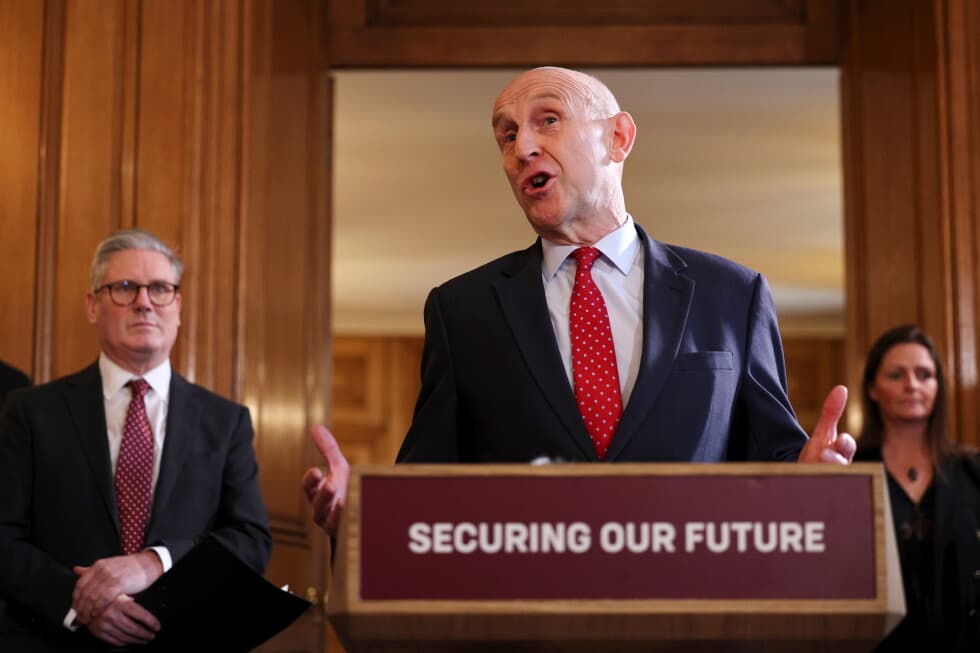
John Healey quits UK defence ministry over Starmer spending plan
John Healey resigned as UK defence secretary after telling Prime Minister Keir Starmer that the government's Defence Investment Plan fell short of what the armed forces need in a more dangerous security environment. Healey said the Treasury plan shown to him would lift defence spending from 2.6% of GDP in 2027 to 2.68% in 2030, while he argued the UK should reach 3% by 2030. Al Carns, the armed forces minister, also resigned and said the plan was both underfunded and too focused on legacy capabilities. Starmer told Healey that the plan would provide sustainable defence increases while protecting public finances, and appointed Dan Jarvis as defence secretary. For Belgium Pulse readers, the story matters mainly as a NATO credibility test: the UK is one of Europe's core military powers, and its choices affect the alliance headquartered in Brussels.
Verified by Validiris·📚 7 sources·🧠 AI-checked·🇧🇪 Belgian: MediumWhy you can trust this
UK Politics and Brexit: Origins to Today
A decade-and-a-half of British politics through the lens of Brexit — from David Cameron's 2013 EU pledge through the 2016 referendum, the long Withdrawal Agreement process, the 2020 exit, and into the post-Brexit Labour government's relationship with Brussels.
About this story
John Healey (Labour MP and UK defence secretary from July 2024 until his resignation on 11 June 2026) had overseen the 2025 Strategic Defence Review. Keir Starmer (UK prime minister and Labour leader since 2020) faces a leadership crisis inside his party. Al Carns (Labour MP, former Royal Marines officer and armed forces minister) resigned after Healey. Rachel Reeves (UK chancellor of the exchequer) controls Treasury spending decisions. Dan Jarvis (Labour MP, former Army major and security minister) has been appointed defence secretary. The Ministry of Defence is the UK department responsible for the armed forces. The Treasury is the UK finance ministry. The Defence Investment Plan is the still-unpublished funding plan meant to implement the 2025 defence review. NATO is the transatlantic defence alliance headquartered in Brussels. Mark Rutte (NATO secretary general since 2024) leads the alliance. Andy Burnham (Greater Manchester mayor) is a possible Labour leadership contender if he returns to Parliament through the Makerfield by-election.
How to read this story
The history
The dispute echoes older British defence reviews in which strategic ambition outpaced budget certainty. The Ministry of Defence says the 2025 Strategic Defence Review was published on 2 June 2025 and set a NATO-first posture, warfighting readiness and a path to 2.5% of GDP by 2027, with 3% in the next Parliament when conditions allow. David Edgerton's 1998 New Left Review essay on Tony Blair's Strategic Defence Review argued that New Labour kept Atlanticist military assumptions and major procurement commitments largely intact. The 2026 rupture shows the same structural tension: global role, US/NATO expectations and Treasury limits.
The geopolitics
The strategic backdrop is a Euro-Atlantic security order under pressure from Russia's war in Ukraine, hybrid threats, missile and drone warfare, and uncertainty over long-term US priorities. NATO's 2025 spending pledge was designed to show deterrence and burden-sharing. The UK crisis reveals the domestic political cost of that shift: alliance credibility now depends on national budgets, not summit language.
Why now
The trigger is the delayed Defence Investment Plan and the settlement Healey said the Treasury presented to him this week. The timing is acute because Starmer faces major allied meetings and Labour pressure, while NATO expects members to show credible spending paths after the 2025 Hague declaration.
What to watch
Watch whether Jarvis publishes a revised Defence Investment Plan before the NATO summit, whether the 18 June Makerfield by-election strengthens a Labour leadership challenge, and whether NATO officials signal concern about the UK's path to the 2035 spending benchmark.
Local impact
The most local Belgian effect is in Brussels, where NATO's headquarters and national delegations will read the UK dispute as part of a broader alliance-delivery problem. It does not change daily life in Brussels, but it affects the institutional community that tracks whether major European allies can turn defence pledges into budgets and deployable capability.
International angle
The resignations land inside a wider NATO debate over whether European allies can reduce dependence on US power while Russia's war against Ukraine continues. The UK is central because it has nuclear forces, expeditionary capacity and a permanent UN Security Council seat. If London struggles to fund its own review, smaller allies will face sharper scrutiny too.
What this means for you
For Belgian readers, nothing changes immediately in services, taxes or travel. The practical takeaway is political: NATO spending pledges are becoming domestic budget choices across Europe. Belgian voters and businesses should expect defence, resilience infrastructure, cyber protection and industrial capacity to remain recurring federal-budget issues as allies prepare annual plans and the 2029 NATO review.
What happens next
Dan Jarvis is expected to steer the Defence Investment Plan toward publication before the next NATO summit, while Starmer must contain Labour discontent before the Makerfield by-election on 18 June 2026. The next signals are whether the plan changes after Healey and Carns resigned, whether more Labour MPs challenge Starmer, and how NATO allies respond to the UK's spending path.
Potential consequences
If the Defence Investment Plan remains close to the figures Healey described, the UK could face doubts about whether its force modernisation matches its NATO rhetoric. A stronger settlement could reassure allies but intensify pressure on public finances and other departments. For Belgium and other European allies, the episode could make defence-budget debates more explicit: governments may be asked not only what percentage they promise, but what military capability the money buys.
Opposing perspectives
- Healey and defence-spending hawks
Healey's resignation letter argues that the UK cannot claim strategic leadership while offering a Defence Investment Plan that he says leaves forces under-resourced. Carns strengthens that view by saying the issue is not only the size of the settlement but whether money shifts quickly enough from older platforms to drones, data, AI and Ukraine-style battlefield adaptation.
- Starmer government and Treasury fiscal disciplinarians
Starmer's response argues that defence cannot be separated from public-finance credibility. In this frame, a rapid unfunded jump in spending could weaken economic resilience, squeeze other departments and make the UK less secure over time. The government position is that sustainable increases, rather than emergency borrowing, are the responsible route to NATO commitments.
- NATO institutional perspective
NATO's Hague declaration frames the issue as an alliance-wide obligation, not a single British quarrel. From that standpoint, the UK dispute is a warning that every ally must turn summit pledges into annual plans, industrial capacity and resilient infrastructure before the 2029 review tests whether the 2035 pathway is credible.
Timeline
- 2024-07-16·The UK government launched a Strategic Defence Review after Labour entered office.
- 2025-06-02·The Ministry of Defence published the Strategic Defence Review 2025.
- 2025-06-25·NATO's Hague declaration set a 2035 target for 5% of GDP in defence and security-related spending.
- 2026-06-11·John Healey resigned as UK defence secretary over the Defence Investment Plan.
- 2026-06-11·Al Carns also resigned from the defence ministry, and Dan Jarvis was appointed defence secretary.
- 2026-06-12·Carns publicly criticised the plan as underfunded and insufficiently focused on future warfare.
- 2026-06-18·The Makerfield by-election is expected to test Starmer's vulnerability inside Labour.
Glossary
- Defence Investment Plan
- The UK funding and procurement plan intended to translate the 2025 Strategic Defence Review into concrete spending decisions.
- NATO Article 5
- The alliance's collective-defence clause, under which members treat an armed attack on one ally as an attack on all.
- GDP defence target
- A benchmark comparing annual defence or security spending with the size of a country's economy.
- Treasury
- The UK finance ministry, responsible for public spending control, taxation and fiscal policy.
Related to this story

Live connections from the Belgium Impulse ecosystem — not recommendations.
This briefing was prepared with AI assistance and reviewed by a Belgium Impulse editor before publication. methodology.