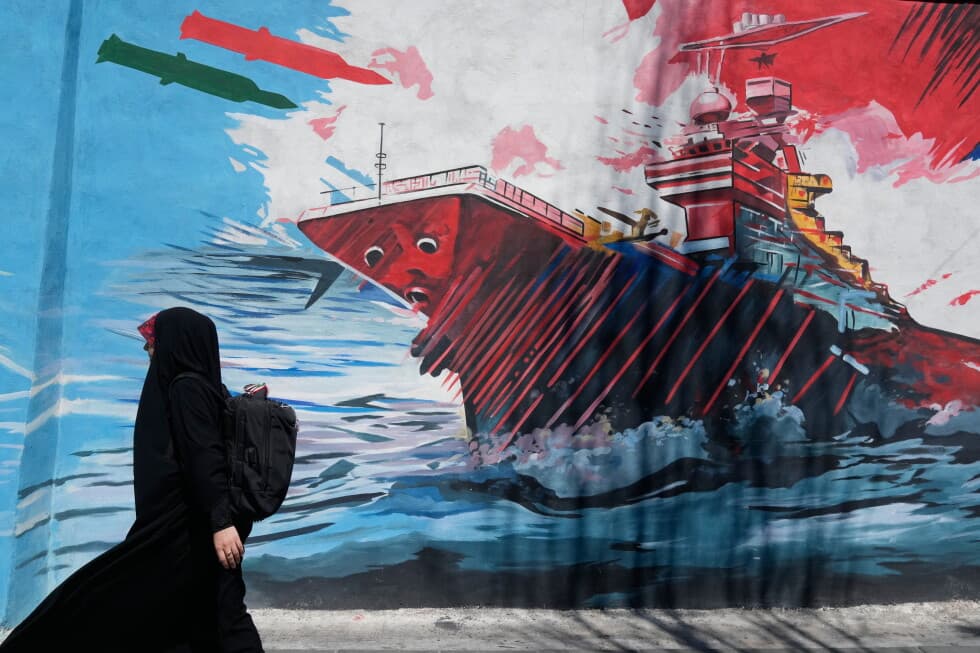
Iran declares Hormuz shut as U.S. says ships still move
Iranian authorities said the Strait of Hormuz was closed after renewed American strikes on Iranian targets, while U.S. Central Command said commercial vessels were still moving through the waterway. The competing claims matter because the strait is not just a military flashpoint: the U.S. Energy Information Administration describes it as a critical oil chokepoint, and market data cited in current reporting show energy prices reacting to the risk that Gulf exports could again be restricted. The latest escalation followed U.S. strikes that U.S. Central Command said targeted Iranian military sites after what Washington called continued Iranian aggression; Iran has framed its response as retaliation for attacks on its territory. For Belgium and the EU, the immediate channel is economic rather than military: fuel, gas, shipping insurance and inflation expectations are all exposed if a political threat becomes a sustained physical blockage.
Verified by Validiris·📚 7 sources·🧠 AI-checked·🇧🇪 Belgian: MediumWhy you can trust this
The Iran Conflict: Nuclear, Regional and Diplomatic
The decades-long confrontation between Iran and its adversaries — the United States, Israel, Saudi Arabia, and proxies across the region — covering the nuclear file, sanctions, the JCPOA collapse, the post-October 2023 escalation, and current diplomatic openings.
About this story
The Strait of Hormuz (narrow passage between Iran and Oman linking the Persian Gulf to the Gulf of Oman) is one of the world's main energy chokepoints. U.S. Central Command, or CENTCOM (the U.S. military command responsible for the Middle East), is the American body denying that transit has stopped. The Islamic Revolutionary Guard Corps, or IRGC (Iran's powerful military-security force created after the 1979 revolution), is central to Iran's maritime pressure campaign. Bandar Abbas, Sirik and Minab (southern Iranian coastal areas near the strait) were named in reports of explosions or strikes. Bahrain, Kuwait and Jordan (U.S.-aligned states that host American troops) were involved in the wider exchange of fire. The U.S. Energy Information Administration (American government energy-statistics agency) tracks chokepoint oil flows. The International Energy Agency (Paris-based energy security body linked to the OECD) monitors emergency energy risks for member states including Belgium.
How to read this story
The history
Iran has repeatedly used Hormuz as leverage without always turning threats into a full, durable blockade. During the 1980s Tanker War, attacks on Gulf shipping led the United States to escort reflagged Kuwaiti tankers under Operation Earnest Will from 1987. In 2019, Iran seized the British-flagged Stena Impero after Britain detained an Iranian tanker near Gibraltar. The current crisis is more dangerous because it combines declared restrictions, reciprocal U.S.-Iran strikes and a market already sensitised by earlier 2026 disruptions around the same chokepoint.
The geopolitics
Hormuz is leverage because it converts a regional military clash into a global economic problem. Iran can threaten a route used by Gulf exporters and Asian buyers; the United States can contest that threat with naval power; Europe absorbs the price and supply consequences despite being outside the battlefield. That makes the strait a pressure point in the wider security order.
Why now
The story is timely because renewed American strikes on Iranian targets were followed by Iran's closure claim and a direct U.S. denial. That turns a broader U.S.-Iran escalation into a specific, verifiable question: are commercial ships still moving through Hormuz?
What to watch
Watch for updated CENTCOM statements, Iranian military notices to mariners, insurer war-risk changes, AIS ship-tracking patterns and oil-price moves over the next several trading sessions. A confirmed tanker strike, mine report or insurer withdrawal would matter more than rhetoric alone.
Local impact
The most concrete Belgian channel is at petrol stations, freight operators and energy-intensive businesses rather than a single commune. Antwerp-Bruges port users, logistics firms and chemical producers would be among the Belgian sectors watching freight, fuel and feedstock costs if insurers or shippers treat Gulf routes as unsafe.
International angle
The dispute sits at the junction of U.S.-Iran military pressure, Gulf state security and EU energy exposure. Brussels matters because EU institutions help coordinate sanctions, diplomacy and energy-security responses, but the centre of gravity remains the Gulf: whether ships, insurers and navies treat Hormuz as open determines the real-world impact.
What this means for you
Belgian readers should expect volatility rather than an immediate, uniform price shock. Fuel and energy contracts may react quickly if markets believe transit is constrained. Businesses dependent on freight, fuel or fertiliser should monitor supplier surcharges and delivery times, while consumers should treat early price movements as risk pricing until ship flows are clearer.
What happens next
The next step is likely a test of facts at sea: ship-tracking data, insurer decisions and any new CENTCOM or Iranian military statements will show whether the closure claim is operational or mostly coercive. Mediation efforts could continue, but further strikes around Bandar Abbas, Sirik or Gulf bases would increase the chance that commercial operators suspend transit voluntarily.
Potential consequences
If the threat persists, Belgium could see higher fuel and gas costs, more expensive freight and renewed pressure on inflation expectations. Farmers and food producers could face knock-on costs if fertiliser and energy markets tighten. A rapid de-escalation would limit the damage, but a cycle of strikes and counter-strikes could make insurers and shipowners treat Hormuz as functionally restricted even without a formal blockade.
Opposing perspectives
- U.S. Central Command
U.S. Central Command's strongest frame is that Iran is overstating control of the waterway: it says commercial ships are still transiting, and it presents the latest strikes as a response to continued Iranian aggression rather than an attempt to close navigation.
- Iranian authorities
Iran's strongest frame is deterrence: Iranian authorities argue that attacks on Iranian territory and U.S. pressure around the Gulf justify using Hormuz as leverage, while presenting retaliation as a defence of sovereignty rather than an attack on global commerce.
- Energy-security analysts
Energy-security analysts frame the dispute less as a binary open-or-closed question and more as an insurance and risk problem: even partial danger, unclear rules or dark transits can raise costs before a complete physical blockade occurs.
Timeline
- 1987·The United States began escorting reflagged Kuwaiti tankers during the Tanker War under Operation Earnest Will.
- 2019-07·Iran seized the British-flagged Stena Impero amid a maritime dispute with the United Kingdom.
- 2026-04-17·Iran said it reopened the Strait of Hormuz to commercial vessels while warning restrictions could return.
- 2026-06-10·U.S. Central Command said it struck targets in Iran after renewed exchanges of fire.
- 2026-06-11·Iranian authorities said Hormuz was closed, while U.S. Central Command said commercial transit continued.
Glossary
- CENTCOM
- U.S. Central Command, the American military command responsible for operations across the Middle East and surrounding waters.
- Strategic oil chokepoint
- A narrow route through which large volumes of oil or fuel must pass, making disruption globally significant.
- IRGC
- Iran's Islamic Revolutionary Guard Corps, a military-security force with major political and regional influence.
Related to this story
Live connections from the Belgium Impulse ecosystem — not recommendations.
This briefing was prepared with AI assistance and reviewed by a Belgium Impulse editor before publication. methodology.