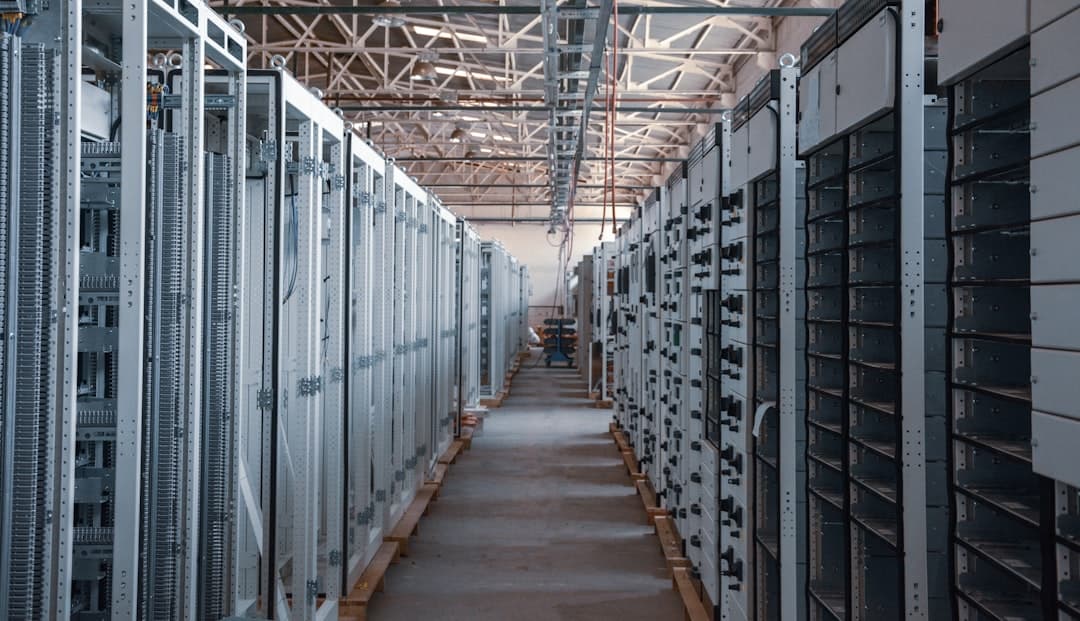
AI data centres force Europe to plan for compute's heat load
AI data centres have moved from a specialist infrastructure topic to an energy-planning issue. The International Energy Agency's 2025 Energy and AI report says electricity for data centres is central to AI deployment, and its modelling expects data-centre electricity demand to more than double by 2030, with dedicated AI facilities driving much of the increase. Recent research on Europe's net-zero pathway adds that AI growth could add 73-723 TWh of European electricity demand by 2050, depending on deployment and efficiency. The practical issue is heat: dense GPU racks turn most incoming electricity into waste heat that must be removed by air, liquid or evaporative systems. For Belgium, the story is not a single new mega-campus but an EU policy question: the Commission is promoting AI Factories and AI Gigafactories while energy rules require better visibility on large data-centre consumption.
Verified by Validiris·📚 8 sources·🧠 AI-checked·🇧🇪 Belgian: HighWhy you can trust this
About this story
International Energy Agency (Paris-based intergovernmental energy body founded in 1974) publishes the Energy and AI report used here for demand modelling. EuroHPC Joint Undertaking (EU, member-state and private-sector supercomputing partnership created in 2018) coordinates Europe's AI Factories. AI Factories (EU-backed supercomputing and support hubs for AI developers) are meant to give SMEs, researchers and public bodies access to computing power. AI Gigafactories (planned very large EU AI training facilities) are described by the European Commission as sites with more than 100,000 advanced AI processors. BE-AIFA (Belgian AI Factory Antenna listed by EuroHPC) links Belgium to the German JAIF AI Factory network. Graphics processing units, or GPUs (chips originally designed for parallel graphics calculations), are now the workhorse hardware for training and running large AI models.
How to read this story
The history
Data centres were once treated mainly as real-estate and telecom assets, but the cloud boom after 2010 made them major electricity customers. The AI acceleration after the launch of widely used generative-AI tools in 2022 changed the density problem: model training and inference need GPU clusters with higher rack power and more concentrated heat. The EU's policy response shifted in 2024-2025 from regulating AI risks under the AI Act toward building sovereign compute capacity through EuroHPC, AI Factories and the Commission's InvestAI agenda.
The geopolitics
AI infrastructure has become part of industrial competition between the US, China and Europe. The strategic asset is no longer only algorithms; it is access to advanced chips, reliable electricity, cooling systems, land, fibre networks and capital. Europe's AI Factory and Gigafactory push is a response to that dependency, but it also imports the physical energy constraints of the compute race.
Why now
The topic is timely because the June 2026 lead follows fresh reporting on data-centre siting and a new European research paper on AI's energy-transition trade-offs. It also lands while the EU is expanding AI Factories and preparing larger AI Gigafactory investments.
What to watch
Watch the next EuroHPC and Commission announcements on AI Gigafactory locations, the criteria used for power and cooling, and whether Belgian firms use BE-AIFA at scale. Energy regulators' data-centre reporting and local permit files will show whether heat reuse and grid costs move from discussion to enforceable conditions.
Regional impact
The EU level is driving the industrial strategy: the European Commission says AI Factories and AI Gigafactories are intended to expand European AI capacity. Belgium's role is more distributed, with EuroHPC listing BE-AIFA as an antenna rather than a full factory. Federal energy-security policy, regional permitting and local heat-network planning would carry different responsibilities if larger sites are proposed. Flanders, Wallonia and Brussels would face the land-use, cooling-water and district-heating questions through their own planning and environmental competences.
Local impact
The most concrete Belgian local angle is Brussels' AI and public-policy ecosystem rather than a single building site: start-ups, universities and public bodies using AI services may seek EuroHPC access through BE-AIFA. If larger Belgian facilities emerge, the local effects would fall on specific municipalities through permits, grid connections, cooling choices and possible heat-network integration.
International angle
The issue is intrinsically cross-border because compute capacity, chip supply chains, electricity markets and cloud services do not stop at national borders. EU policy is trying to reduce dependence on US and Chinese infrastructure while keeping AI deployment compatible with energy-security and climate goals. Belgium enters through the EU framework and its role in the EuroHPC network.
What this means for you
For Belgian businesses and researchers, the practical takeaway is to track EuroHPC access routes before buying expensive private compute. For citizens and local officials, the relevant questions are simple: who pays for grid upgrades, what cooling method is used, whether waste heat can be reused, and whether the site competes with other electrification priorities.
What happens next
EU institutions are expected to keep expanding AI Factory access while developing the larger AI Gigafactory agenda. Belgian users can watch how BE-AIFA connects companies and researchers to the EuroHPC network. The harder next step is whether EU and Belgian energy rules translate data-centre reporting into enforceable planning on grid capacity, heat reuse, cooling and water.
Potential consequences
If AI demand grows faster than grid investment, Belgium and neighbouring countries could face tougher choices between data-centre load, industrial electrification, heat pumps and electric mobility. Well-sited facilities could also supply reusable low-temperature heat for district networks, but that requires local planning and customers nearby. The biggest policy risk is treating compute as intangible software while the energy system experiences it as a large, continuous physical load.
Opposing perspectives
- European Commission / EuroHPC
The Commission and EuroHPC frame AI Factories as industrial infrastructure that gives European SMEs, researchers and public authorities access to compute capacity that would otherwise be dominated by non-European hyperscalers. Their strongest argument is that Europe cannot regulate AI effectively or compete globally without building some sovereign computing base.
- Energy-system researchers
The 2026 European modelling paper argues that AI demand can fit within net-zero pathways only if policy accounts for timing, location, efficiency and firm-power needs. The steelman is not anti-AI; it is that unmanaged siting could raise system costs and emissions during the transition years.
- Data-centre operators
The Data Center Coalition says operators work with local authorities and invest in water stewardship and infrastructure. Its strongest case is that data centres remain smaller water users than agriculture or power generation and that closed-loop cooling and better procurement can reduce local stress.
Timeline
- 2024-01-24·The Commission adopted its AI Innovation Package, identifying AI Factories as a strategic priority.
- 2025-04-10·The International Energy Agency published Energy and AI, modelling data-centre and AI electricity demand.
- 2026-06-08·A European research paper modelled AI's possible effect on Europe's net-zero energy pathway.
- 2026-06-11·The Al Jazeera lead highlighted public interest in AI data-centre heat and location.
Glossary
- EuroHPC JU
- The European High Performance Computing Joint Undertaking, an EU partnership that funds and coordinates supercomputing infrastructure.
- AI Factory
- An EU-backed hub combining supercomputing capacity, data, expertise and support services for AI users.
- AI Gigafactory
- A planned very large AI training facility that the Commission says would combine more than 100,000 advanced AI processors with high power and networking capacity.
- BE-AIFA
- Belgium's AI Factory Antenna in the EuroHPC network, listed as linked to Germany's JAIF AI Factory.
- GPU
- A graphics processing unit, a chip suited to parallel calculations used heavily in AI training and inference.
Related to this story


Live connections from the Belgium Impulse ecosystem — not recommendations.
This briefing was prepared with AI assistance and reviewed by a Belgium Impulse editor before publication. methodology.