Can you still visit the Hautes Fagnes after the fire—and where must you stay away?
Police and forest officers recorded roughly 15 violations around the closed Hautes Fagnes fire zone over 5–6 September 2026, according to Wallonia’s official update.
In 30 seconds
- Wallonia reported roughly 15 enforcement actions over 5–6 September.
- SPW warns that peat fires can persist underground for weeks.
- VISITWallonia promotes alternatives outside inaccessible areas.
- Access information must be checked for the specific route and travel date.
Police and Département de la Nature et des Forêts officers recorded roughly 15 violations around the Hautes Fagnes fire perimeter over 5–6 September 2026, according to the governor’s update published by Wallonia. For anyone planning a walk or cycle ride, the practical message is to check the precise route before leaving and respect closures on arrival. The update maintains the prohibition on entering the burned perimeter. [Wallonia’s situation report](https://www.wallonie.be/fr/actualites/incendie-dans-les-fagnes-ce-14-aout) is the starting point for checking restrictions.
The enforcement tally does not establish why each person entered the area. Although the supplied DH headline raises concern about disaster tourism, the accessible official account does not identify visitors’ motives or give individual penalty amounts. Curiosity, confusion and deliberate disregard should not be treated as interchangeable without evidence. What matters for a prospective visitor is simpler: an attractive route on a walking app is not proof that access is permitted today.
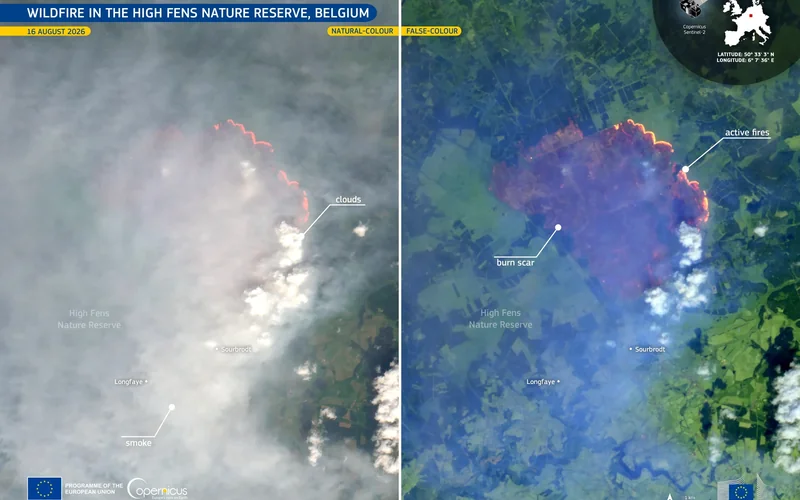
The physical reason for caution extends beneath the landscape. In its 28 August update, the Service public de Wallonie’s environmental administration explains that peat can continue burning underground for days or weeks before fire returns to the surface. It recorded a flare-up north of Clefaye that affected approximately six additional hectares on 27 August. The absence of visible smoke therefore cannot establish that a path is safe. These restrictions protect both visitors and the teams still working in a damaged environment, the administration says. [SPW environmental update](https://environnement.wallonie.be/actualite/incendie-dans-les-hautes-fagnes-14-aout).
Local broadcaster Vedia supplied a concrete illustration on 4 September. Speaking to the station, SPW spokesperson Nicolas Yernaux said probes had still detected temperatures of 70–80°C at some points underground. His account helps explain why a landscape that appears quiet can remain an intervention site. It also gives visitors a useful distinction: containing the spread of a fire and making a place suitable for ordinary recreation are separate tasks. A photograph cannot tell you whether the second has been completed. [Vedia’s field report](https://www.vedia.be/info/les-fagnes-se-consument-toujours-et-pour-des-semaines-encore/214148).
For drivers, the governor’s 6 September update specifies that the N68 between Belle-Croix and Eupen remains closed through at least 13 September, with stopping and parking prohibited on national roads bordering the perimeter. Treat that as a dated restriction, not a promise of reopening the following morning. Recheck the official page before travelling; a road journey and the walk that follows need separate checks. [Wallonia’s access and mobility guidance](https://www.wallonie.be/fr/actualites/incendie-dans-les-fagnes-ce-14-aout).
There are constructive alternatives to abandoning a visit altogether. In its 31 August announcement, VISITWallonia directs visitors towards the wider region, including Malmedy and the Malmundarium, Reinhardstein castle and routes around Lake Bütgenbach. Its “Les Hautes Fagnes autrement” information brings together activities and access advice. These are ideas to investigate, rather than unconditional assurances that every connecting path is open. Ask an accommodation provider or attraction about your intended journey, including the start point, parking and any connecting trail. That produces a more useful answer than asking whether “the Fagnes” are open. [VISITWallonia’s visitor guidance](https://presse.visitwallonia.be/fr-be/communiques-de-presse/les-hautes-fagnes-autrement).
The distinction matters economically as well as practically. A survey published by tourism minister Valérie Lescrenier’s office on 1 September received responses from 258 accommodation establishments out of 1,128 approached across 14 communes. Among respondents, 88 had closed temporarily, disrupting stays for nearly 1,740 visitors. The ministry explicitly cautions that the response rate limits interpretation. Those figures are an indication of disruption, not a complete regional loss estimate. For someone with a booking, the sensible next step is to ask what remains possible locally before assuming the whole stay must be cancelled. [Tourism ministry assessment](https://lescrenier.wallonie.be/home/communiques-de-presse/presses/hautes-fagnes-la-reprise-s-organise-l-avenir-se-construit.html).
Language also deserves a little preparation. The same survey covered nine German-speaking and five French-speaking communes, illustrating why French-only searches may provide an incomplete practical picture. Wallonia offers a German version of its incident information. Keep the exact place names and route details from your booking when seeking advice, and translate any unfamiliar closure notice before proceeding. Do not infer permission from a sign you cannot understand. This is a region where checking the relevant commune’s information can be more useful than relying on a general description of a Belgian walking destination.
The broader lesson predates this fire. In an April 2025 warning, the SPW recalled that the Hautes Fagnes fire of 25 April 2011 burned 1,200 hectares. That history does not establish the cause of the present incident, but it puts access controls in perspective: protecting this landscape has long involved managing public entry during dangerous conditions. The enduring visitor habit is to treat access information as part of planning, alongside weather and transport. [SPW’s historical and prevention briefing](https://spw.wallonie.be/sites/default/files/2025-04/risque%20d%27incendie%20%C3%A9lev%C3%A9.pdf).
What follows will require patience. Lescrenier and German-speaking tourism minister Gregor Freches describe recovery as a gradual process involving safety, restoration and eventual public return. Their approach leaves room for visits elsewhere while damaged areas recover. The reporting reviewed here establishes no general reopening date for the burned perimeter. Before your next outing, check the latest official restrictions, confirm the particular activity you want to do and be ready to change the route. [The ministers’ recovery statement](https://lescrenier.wallonie.be/home/communiques-de-presse/presses/hautes-fagnes-la-reprise-s-organise-l-avenir-se-construit.html).
What to do
Check official information on the day of travel, confirm arrangements with your provider and follow barriers and local signs.
The Belgian angle
The tourism ministry’s survey documents accommodation disruption across French-speaking and German-speaking communes, while warning against extrapolating from its limited response rate.
EvidenceWell established · 1 primary source + 4 official documents + 1 independent reporting source · Background sources: 1Explore evidence →Hide evidence ↑
- Published:
- 14 Aug 2026, 02:00
- Retrieved by ODIN:
- 8 Sept 2026
- Published:
- 19 Aug 2026, 02:00
- Retrieved by ODIN:
- 8 Sept 2026
- Published:
- 4 Sept 2026, 02:00
- Retrieved by ODIN:
- 8 Sept 2026
- Published:
- 31 Aug 2026, 02:00
- Retrieved by ODIN:
- 8 Sept 2026
- Published:
- 1 Sept 2026, 02:00
- Retrieved by ODIN:
- 8 Sept 2026
- Published:
- 1 Apr 2025, 02:00
- Retrieved by ODIN:
- 8 Sept 2026
- Published:
- 8 Sept 2026, 02:00
- Retrieved by ODIN:
- 8 Sept 2026
Continue reading
This story was assembled from verified evidence, with its sources and reasoning recorded as it was written.
This briefing was prepared with AI assistance and passed Belgium Impulse source, provenance and publication-quality checks. methodology.